Place: Fish Creek Bridge, Wilson WY
Time: 5:00 pm
Temp: 46 degrees
Weather: Sunny, with some clouds
Wind: a cold breeze
Soil: dry
My observation spot has changed so much since the first week I observed this area! On the first week, there was hardly and grass or other flora, and i saw more fauna, such as moose and more types of birds. As the weather has changed so has the organisms in my area. I have observed the willows bloom, swallows form round nests made out of wood and mud. I know that this is an antipredator adaptation because the nests are the same color as the trees and ground. I have also noticed the aspens come to life in their grove. They grow in a grove beecuase their roots are connected under ground. The water in the creek has risen at least half a foot and is going way faster than it was at the beginning. I observed mallards again, but or the first time I only saw a male. I predict that the eggs were already well-incubated so the male left to find a flock of other males. During the last few weeks i have observed many interactions between organisms, from competition to predation to mating. I have observed mutualistic relationships: the two mallards mating, a commensalistic relationship: where one organism (the tree) remains unaffected and the other (the moss) is benifited. I predict that as the temperature rises there will be more and more bugs. I also predict that more rain will come and the water level will rise and some organisms will leave, and others (like different kinds of fish, birds, an insects) will arrive.
Friday, May 30, 2008

Thursday, May 29, 2008
Observation 7
Place: Fish Creek Bridge, Wilson WY
Time: 5:00 pm
Date: May 27, 2008
Temp: 50 degrees
Wind: Very blustery
Weather: Not raining, but it has been, clouds collecting in sky
Soil: Gettting dryer, but moister becuase of rain.
Today it was very gloomy out, and i didnt observe very many animals. The flora hasnt changed much since my last observation, except the hills near my observation site have these daisy-like flowers growing up in bunches all over the hill. I predict that these are blossom rooted flowers, with leaves that look like arrow heads. The water level has risen by alot since the first week I observed my area, and the water is much swifter. I didnt observe many interactions between organisms except for two swallows flying together. I think that this is a mutualistic relationship because they both benifit. The enviroment is changed because of these swallows because they make little round nests in the willows and on the banks of the creek. I havent observed the mallards for a while, and i predict that because the seasons are changing, their habitats might be changing as well. i alo predict that the food chain and web would change becuase the animals thtat mallards eat will be more plentiful, and the organisms that eat mallards in my area will probably find other places to find food, possibly move with the mallards.
Wednesday, May 28, 2008
Flora Report

Sarah Ross
Ms. Overly
Environmental Geology
Pd. 2
May 26, 2008
ASPEN TREES
Quaking Aspens, or populous tremuloides, are found as different species all over the world, but American Quaking Aspens are often found in the Northern Eastern part of the country, where we can observe them. They are tall pale trees that can be up to 70 meters, and have beautiful vibrant leaves that we are lucky to enjoy in the fall. They often live on north or east facing slopes that have access to water, because they need to be in a very moist area with a lot of sunlight to do well. Water is their food source, and the little veins in their leaves carry nutrients to help the tree be healthy. Their leaves also serve as food for animals like caterpillars. Their bark is very pale, powdery white, with back knots. If you rub your hands on the bark and get the white powdery bark on it, it can serve as sunscreen. Aspen Trees serve as home to many different animals. They provide a shady place for some types of flora to grow, and I observed a nest that appeared to be a red-tailed hawks nest. Aspens are a thriving community in Jackson Hole, but they have two threats two their species: a form of bark beetle that usually affects only conifer trees has begun to infect aspens. They are also in constant competition with conifer trees or space, but because aspens can only grow in groves, they cant win very often.
works cited
Works Cited:
Flora:
Wikipedia.com. May 15, 2008. Wikipedia. May 28, 2008. http://en.wikipedia.org/wiki/Aspen
Barnard, Edward, Sharon Yates. Trees and nonflowering Plants. Pleasant New York/Montreal. Readers Digest association. Copyright 1998.
Mark Moritsch. Autumn Foliage and Tree Trunks of Quaking Aspen Trees in the Crested Butte Area of Colorado. May 28, 2008. http://images.google.com/imgres?imgurl=http://imagecache2.allposters.com/images/pic/NGSPOD05/111392~Autumn-Foliage-and-Tree-Trunks-of-Quaking-Aspen-Trees-in-the-Crested-Butte-Area-of-Colorado-Posters.jpg&imgrefurl=http://www.allposters.com/-sp/Autumn-foliage-and-tree-trunks-of-quaking-aspen-trees-in-the-Crested-Butte-area-of-Colorado-Posters_i1016400_.htm&h=425&w=318&sz=41&hl=en&start=2&tbnid=jyBEIAeP8RQ8mM:&tbnh=126&tbnw=94&prev=/images%3Fq%3Daspen%2Btrees%26gbv%3D2%26hl%3Den
Fauna:
Sibley, David. The Sibley Guide to Birds. New York: Chanticleer Press, Inc. 2000
Wikipedia May 27, 2008. Wikipedia. May 28, 2008. http://en.wikipedia.org/wiki/Mallards
Richard Seamen. Two Mallards. May 28, 2008 http://images.google.com/imgres?imgurl=http://www.richard-seaman.com/Wallpaper/Nature/Birds/Swimmers/TwoMallards.jpg&imgrefurl=http://www.richard-seaman.com/Wallpaper/Nature/Birds/Swimmers/index.html&h=768&w=1024&sz=232&hl=en&start=1&tbnid=goawHuJ9pap0TM:&tbnh=113&tbnw=150&prev=/images%3Fq%3Dmallards%26gbv%3D2%26hl%3Den
Flora:
Wikipedia.com. May 15, 2008. Wikipedia. May 28, 2008. http://en.wikipedia.org/wiki/Aspen
Barnard, Edward, Sharon Yates. Trees and nonflowering Plants. Pleasant New York/Montreal. Readers Digest association. Copyright 1998.
Mark Moritsch. Autumn Foliage and Tree Trunks of Quaking Aspen Trees in the Crested Butte Area of Colorado. May 28, 2008. http://images.google.com/imgres?imgurl=http://imagecache2.allposters.com/images/pic/NGSPOD05/111392~Autumn-Foliage-and-Tree-Trunks-of-Quaking-Aspen-Trees-in-the-Crested-Butte-Area-of-Colorado-Posters.jpg&imgrefurl=http://www.allposters.com/-sp/Autumn-foliage-and-tree-trunks-of-quaking-aspen-trees-in-the-Crested-Butte-area-of-Colorado-Posters_i1016400_.htm&h=425&w=318&sz=41&hl=en&start=2&tbnid=jyBEIAeP8RQ8mM:&tbnh=126&tbnw=94&prev=/images%3Fq%3Daspen%2Btrees%26gbv%3D2%26hl%3Den

Fauna:
Sibley, David. The Sibley Guide to Birds. New York: Chanticleer Press, Inc. 2000
Wikipedia May 27, 2008. Wikipedia. May 28, 2008. http://en.wikipedia.org/wiki/Mallards
Richard Seamen. Two Mallards. May 28, 2008 http://images.google.com/imgres?imgurl=http://www.richard-seaman.com/Wallpaper/Nature/Birds/Swimmers/TwoMallards.jpg&imgrefurl=http://www.richard-seaman.com/Wallpaper/Nature/Birds/Swimmers/index.html&h=768&w=1024&sz=232&hl=en&start=1&tbnid=goawHuJ9pap0TM:&tbnh=113&tbnw=150&prev=/images%3Fq%3Dmallards%26gbv%3D2%26hl%3Den

Friday, May 23, 2008
Observation 6
Place: Fish Creek Bridge, WIlson WY
Time: 5:30 pm
Day: May 22, 08
Temp: 44 degrees
Weather: Very wet and rainy
Wind: A little breezy
Today is very different than my other observation days because it is very rainy, and there are not very mnay organisms probably becuase it is so rainy. I only observed two birds, which I think were White-throated swifts which seem to be in competition with eachother over resources. They also seem to be here quite often. I think that the birds white-chest is an anti-predator adaptation because with the black back, they can blend into the willows and trees and dirt, and the white probably looks a little bit like sky from below. Camoflauge is a very common but effective adaptation. I noticed a commenstalistic symbiotic relationship between moss and trees, where the moss benifits by the trees becuase it has a place to grow, but the trees remain unaffected. I know that these trees are some kind of the conifer species, but I'm not sure what. I predict that when this storm passes alot of new flora species will be in my area, like more flowers and bushes, which increases competition over space.
Wednesday, May 21, 2008
Observation 5
Place: Fish Creek Bridge, Wilson WY
Time: 5:00 pm
Day: 5/20/08
Temp: 50 degrees
Weather: Rainy and cloudy
Wind: Very windy, but in gusts
Soil: Really damp because of the rain
Today the area has changed so much since last week! There are blossoms on the willows, and the grass is grown and all over the place, with no remaining snow. The creek is going faster and the water has risen since the rain. I predict that if they rain continues, the next time I observe my football-sized area, it will be very damp and the water will be much higher.
Today I observed two birds which I predict White-Throated Swifts, which were either a couple, or one was a baby. White-Throated Swifts carry food for their yound in an expandable throat pouch. Again I observed mallards, who I see almost every time I drive by the creek. Right now I am observing plant life between the flora, because as all the plants grow, there is less and less room. Right now grass seems to be overtaking the flower type shrubs that are trying to grow, but i predict these shrubs wont be able to grow because they dont get enough sunlight through the willows. The Aspens are growing, and I predict that plant life below them will probably cease to grow as well, since a grove of aspens are always connected by its roots under ground, not leaving much space for other organisms to grow. I usually see moose here, but lately I havent seen any, and I am wondering if the weather just wont allow it, or if they move with the season change. Every day I see more and more insects, who seem to be breeding under the rocks. I predict that as the weather gets warmer, mosquitoes will arrive. I also observed alot of worms today. It will be fun to see if the watery weather causes the increase in organisms, or the decrease in organisms.
Monday, May 19, 2008
Fauna Report

Sarah Ross
Ms. Overly
Pd. 2
May 8, 2008
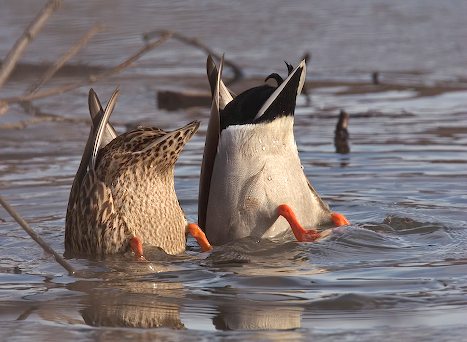
Mallard ducks, or Anas plytyrhynchos, are the most plentiful and the most hunted ducks in North America. They live in the majority of the North America, wintering in Florida, Georgia, North and South Carolina, Mexico, Texas, and other southern states. They live year round in the middle region of the country, and summer in the Northern states like Wyoming, Idaho, parts of Canada, and Montana.
Mallards are the largest of domestic ducks at about 26 inches in length, and can be up to 3 pounds. Mallards form pairs until the eggs are well under way being incubated and then the males leave their mate and find a group of other males to be with. A flock of mallards together are called a “sord.” A male can win over a female by showing dominant behavior or pestering another male until he goes away. Males have an iridescent green head; an adaptation made to attract females, while females have adapted to their environment by camouflaging themselves to their environment, a dull brown color. Mallards can live as long as eleven years, but mate from 7-11 months old. Mallards are foragers, and dabble for 90% of their food at the bottom of creeks. They eat millet, wild rice, and saw grass. The other 10% of their diet is animal matter, such as water beetles and leeches.
Although they are not under too much danger, the number one threat to their species is hybrid breeding. Mallard’s predators are coyotes, wolves, and, unfortunately humans. Mallards are not yet endangered, but they play a key role in the food web by keeping populations of insects and leeches down. Because they play a key role in the environment, humans should try to protect them more, and therefore keep mallard’s habitat healthier.
Friday, May 16, 2008
Observation 4
Place: Fish Creek, Wilson Bridge
Time: 5:00 pm
Date: 5/15/08
Temp: 60 degrees
Wind: close to none
Soil: still moist from rain that it absorbed
I observed two mallards, a male and a female, and I wonder if these are the same two I have been observing. I hypothesise that right before I began to observe this area, there was some competition over the female, and the more dominant male won. Some of the other organisms I observed was a deer (up on the hill, not really by the creek) and alot of insects, which I predict are mayflys, even though it may still be too cold to provide for their survival needs. Mallards often dabble for insects at the bottom of creeks, and I wonder if they eat these little mayfly type bugs. I also observed some robins, and close to no new plant life since the last time I came to my area. Some of the abiotic factors I have observed are large boulders on the banks. One of the larger ones is growing lichen, which could be primary sucession. I dont think that my area was affected by the Green Ole' Fire but if it was, that would be an example of secondary succession, where the area would grow more plantlife, and more diverse organisms in the area. This thriving communitiy seems to be doing well, and getting better. Every different population I have obsereved helps the ecosystem in their own way. For example I obvsered a dead bird, which will degrade, and transfer energy, helping it's habitat thrive.
Observation 3
Place: Fish Creek, Wilson Bridge
Temp: 55 degrees
Time: 4:00 pm
Day: 12, 2008
Wind: Breezy
Soil: Moist becuase of rain
Today I observed two birds that I think were Cliff Swallows fighting over food, or interspecific competition. The water in the creek has risen again since the rain, and the last of the snow has melted. The biodiversity has increased since new plant life has come in. The grass is everywhere now, and the willows have little buds on them. The aspens are beginning to grow little leaves. I observed a mother moose and a baby moose, eating the willows. I also observed one male mallard again, who probably just mated, and left his mate to go find a flock of males. The temperature has gotten colder since the last time I observed my area, but I predict that as the temperature rises the amount of species will increase, and I am excited to see the interactions of the new species. Some of the plant life I have been observing are species of conifer trees, that I predict are pines or aspens. I also observed a bee, which means there must be some flowers around to pollinate. I predict that sticky-geraniums will grow in my observation area.
Sunday, May 11, 2008
Observation 2
Place: Fish Creek Bridge, Wilson WY
Date: 5/11/08
Time: 9:35 am
Temp: 51 degrees
Weather: Sunny, with clouds accumulating near the Grand
Wind: Cold, but not very strong
Soil: Dry, moister with runoff. Grass sprouting up
Today at the Fish Creek bridge I observed two Canadian Geese and, again, many species of insects. Some of them seem to have been here for I long time, and I wonder if they managed to live in such a harsh enviroment over the winter. The aspens are beginning to pollinate, and the trees that I believe are Cottonwoods have fluffy, cottony, caterpillar looking things hanging off their branches. There is about double the grass in my area than there was last week. The water level has also risen, and is swifter than last week. Again, I saw mallards, which seem to live comfortabley in this habitat. The niche the occupy is as follows: Mallards usually live in wetlands, in small ponds or streams. They usually nest on the banks of creeks or rivers, but not necessarily close to the water. They eat by dabbling for plants at the bottom of the creek. They do have many predators. Fish creek seems to be their home, and whenever I walk or drive by, I can hear them. I hypothesise that the next time I observe my area, the grass will all me grown and green, and the remaining snow on the banks will be melted, with the creek level rising some more. I also believe more and more organisms will begin to move into this area as food becomes more ample.
Friday, May 9, 2008
Observation 1
Place: Wilson Bridge, Fish Creek
Date: 5/5/08
Time: 5:00 pm
Temp: 60 degrees
Weather: Sunny, with clouds
Wind: Breezy
Soil: Dry and rocky, moister closer to water
The observation area is the Wilson Bridge, where I am mostly observing the Biotic and Abiotic factors under the bridge. The organisms I observed were two mallards, a male and a female, a robin, a moose and a red tailed hawk. I also observed many insects under rocks in slimy, green, algae. This community is very biodiverse. The flora around the area is willows (that the moose eat) and green grass sprouting up on the banks. I predict that as the temperature rises and the snow begins to melt, the flora will come back to life, and the enviroment will increase in biodiversity. I also predict that as the snow melts the water level will rise (right now at it's deepest it is about 1.5 feetl.)
Subscribe to:
Posts (Atom)